Most automation and AI programmes promise speed and efficiency, but they often fall short. Not for lack of effort or ambition, but because the pieces just don’t connect. A perfect example is the spiralling costs of NS&I’s business transformation programme (source: Parliament.uk), partly because the bank had no agreed and integrated plan in place, nor the right skills and expertise.
Big automation projects can be very complex, involving legacy systems, new technologies, and multiple vendors and internal teams, each with their different ways of working. Combine these structural challenges with other potential obstacles, such as vendor handoffs, incomplete documentation and knowledge trapped in people’s heads and it’s easy to see why automation projects stall, overrun or go over budget.
A new approach is needed.
Automation needs vertical integration
Vertical integration is a deliberate strategy where a business takes ownership of two or more key stages of the journey end-to-end.
In food terms, think of it as a restaurant that grows its own fruit and vegetables, develops recipes that best showcase these prized ingredients, and cooks them to perfection for its valued guests.
At EGA Tech, our vertically-integrated strategy comprises talent acquisition, training & development, and automation delivery. We source the best DevOps candidates; develop their skills using our proprietary, AI-driven EGA Knowledge platform for continuous learning; and assemble the most effective automation teams so that our clients benefit from faster project delivery, better learning outcomes and increased operation efficiency.
It’s a far cry from the traditional IT services model where an enterprise client has to rely on recruitment agencies, training providers, software vendors and systems integrators just to get an automation project off the ground. It often leads to a compromise on quality, spiralling costs, or badly deployed projects, especially when knowledge gets lost between handovers, or when team members leave mid-project.
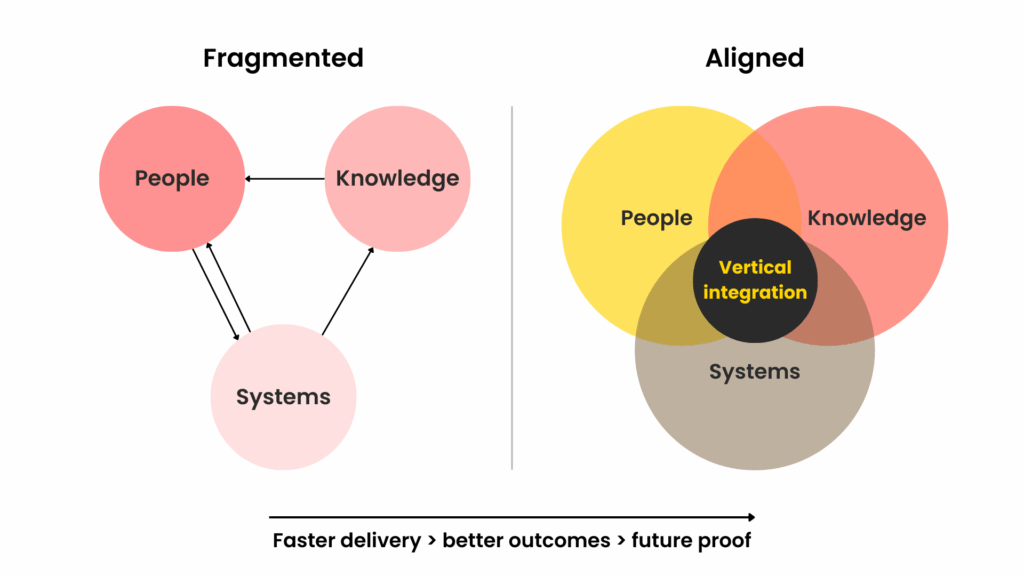
How EGA Tech approaches vertical integration
Our unique ecosystem has four distinct, but simple layers:
Talent
- EGA Tech sources, trains and manages the day-to-day performance of our DevOps engineers
- Our focus on depth and breadth of skills means that we always have the right DevOps stack available for automation projects
Learning & knowledge
- We built our own proprietary, AI-driven Knowledge platform to train and upskill our DevOps engineers
- Training content is created quickly and updated continuously, ensuring close alignment with our clients’ requirements
Delivery
- EGA Tech manages the day-to-day performance of our DevOps engineers so that clients can benefit from high-velocity, rapid deployment
- Because our talent is trained within our own integrated system, we can deploy them with shared methods, tools and understanding. EGA Tech DevOps engineers are fully aligned, not assembled
Technology & IP
- All tools we develop and use ourselves are also offered to clients and internal teams
- EGA Tech trains internal teams and provides clear documentation so that in-house engineers can extend and manage modules with confidence at any point in the future
Continuous learning must be built-in from the outset. It underpins a project’s full lifecycle: from onboarding and delivery to post-delivery support.
While external vendors can take up to four weeks to provide resources, EGA Tech cuts this down to a week. With continuous learning embedded, even when engineers are not actively working on customer projects, we put them on the bench. Rather than this being ‘dead’ time, we assign them internal projects or ‘out-of-scope’ client work that we know will enhance existing projects. As this is all real work, they sharpen and expand their skillset, but more importantly from a client perspective, engineers remain available for immediate client deployment.
Clients have faster access to skilled DevOps, which significantly improves onboarding and project completion times, lowers delivery risks and reduces friction during live project stages.
Building sustainable automation that lasts
Automation by definition applies technology, programmes, robotics or processes to achieve outcomes with minimal human intervention. However, humans must understand how it works and how to fix it when things break. A module, project or programme therefore isn’t complete without full and comprehensive documentation, version management and 24/7 enterprise support where needed.
For automation projects to continue delivering results in the long term, continuous learning must be built-in from the outset. It underpins a project’s full lifecycle: from onboarding and delivery to post-delivery support. Upon completion, clients benefit from better handovers, knowledge that is actually captured and is easily accessible in a variety of formats to suit every internal team member.
The purpose of vertical integration isn’t control; it’s about building resilient structures. When people, knowledge and technology are fully aligned and interconnected, organisations like ours can move faster, fail less and ultimately deliver better results for our clients.
If you want to learn about our vertically-integrated automation model and how it can transform your project delivery, then get in touch via info@ega-tech.co or leave your details below.